 VitaroUNO INDUSTRIAL
Roof build-up
Pedestal Slope Corrector & Waterproofing Membrane: Levelling Falls and Protecting Roofs
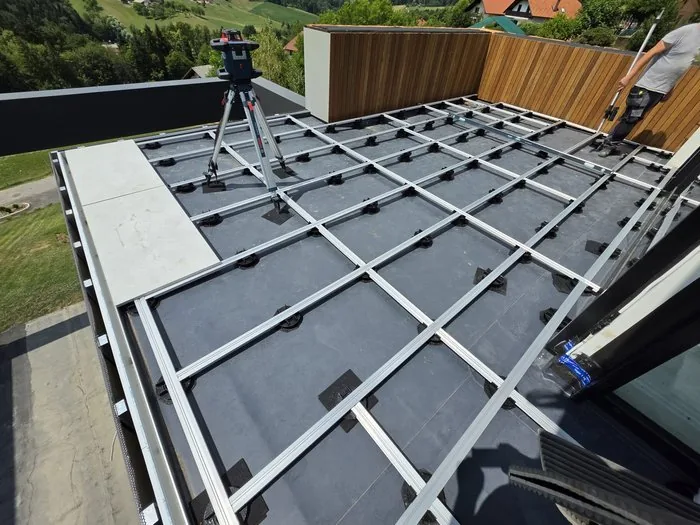
Most "flat" roofs are not flat. They carry a designed fall for drainage, the structural slab often cambers or settles, and terraces are routinely built over a single-skin waterproof membrane that you cannot puncture. That is exactly the problem an adjustable pedestal slope corrector solves: it lets you build a perfectly level deck or paved terrace above an uneven, sloped, water-sensitive roof. This guide covers how slope correctors work, how they protect the membrane, and why pedestals do not damage roofing when used as intended.
1. What a slope corrector pedestal is
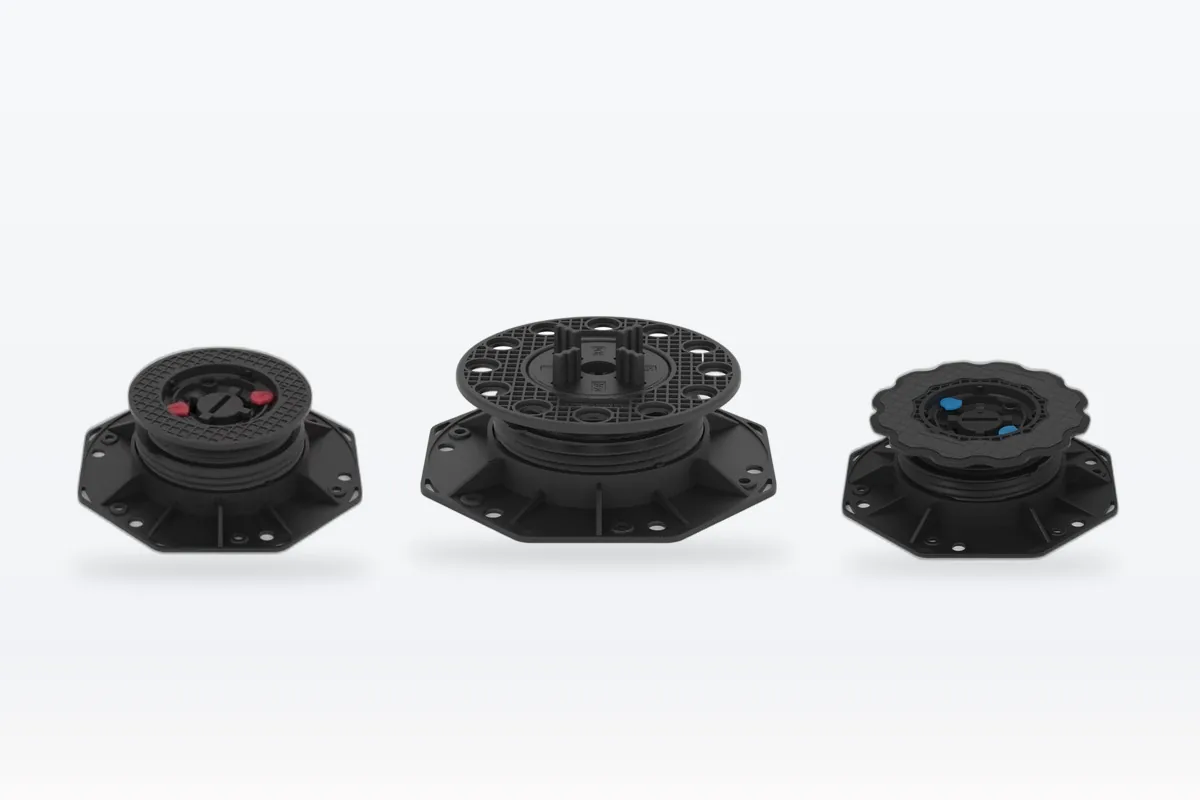
A slope corrector pedestal is an adjustable support whose head automatically tilts to follow the local substrate slope. On a roof or cambered slab this means the finished paving or decking stays level even though the base beneath is not. Vitaro's self-levelling heads compensate falls of roughly ±5° without shimming, so terraces and podiums read as flat from above. Where the fall is larger or inconsistent, a dedicated slope-corrector ring or wedge can be added under the head to take up the difference.
This is the same principle behind our adjustable vs fixed support comparison: the pedestal carries the height adjustment, and the head carries the angle correction — two jobs, one component.
2. How it levels a sloped roof
The mechanism is simple and dry:
- Set the body height. Each pedestal screws to the target finished height above the structural deck.
- The head follows the fall. The self-levelling head pivots to match the local roof slope, so it presents a level seating for the joist or paver above.
- Independent levelling. Because every pedestal levels on its own, a grid of them rides the entire roof fall and produces a single flat plane — no cutting, no mortar, no wet trades.
- Open grid beneath. The void between pedestals keeps the designed drainage falls clear and the membrane visible for inspection.
That is why a roof pedestal is the default choice for terraces and podiums over occupied or waterproofed levels.
3. Protecting the waterproof membrane
The membrane is the one element you must not compromise. An adjustable pedestal over a waterproofing membrane is safe by design because:
- No penetration. Pedestals are placed on top of the membrane — there are no fixings, screws or holes to leak.
- Load spread. A base pad spreads the pedestal's point load across a wider area, limiting pressure on the membrane.
- Inspectable & drainable. The open grid keeps the membrane fully visible for surveys and leaves drainage falls unobstructed.
So the short answer to a common buyer question — will adjustable pedestals damage the waterproof membrane? — is no, not when specified and installed correctly. The pedestal system is actually the more membrane-friendly option versus bonded or mechanically fixed build-ups.
4. Membrane protection pads
A pedestal roof membrane protection pad is a thin, tough washer (rubber or HDPE) placed between the pedestal base and the waterproofing. It does two jobs:
- Spreads load so the membrane does not see a hard point pressure.
- Guards against abrasion from installation handling and thermal movement of the pedestal.
Use a pad under every pedestal wherever the membrane is a single-skin waterproofing layer. It is a small, cheap addition that protects the most expensive thing on the roof.
5. Flat roof vs sloped roof
| Condition | What you need | Why |
|---|---|---|
| Designed fall 1–2% (typical "flat" roof) | Standard adjustable pedestal with self-levelling head | The head auto-corrects small falls; finished surface stays level. |
| Large or inconsistent slab fall | Pedestal + slope-corrector ring/wedge | Takes up bigger angle differences between pedestals. |
| Single-skin waterproofing | Membrane protection pad under every base | Spreads load and prevents abrasion of the membrane. |
| Pedestal on flat roof membrane vs pavers bonded down | Pedestal system | No penetration, fully reversible and serviceable. |
For decking finishes, see the deck pedestal and paver pedestal ranges; both use the same self-levelling heads over roofs and slabs.
6. Quick reference table
| Item | Role | Vitaro note |
|---|---|---|
| Self-levelling head | Compensates slab fall up to ~±5° | Standard on HE / XA-HE / XB-HE |
| Slope-corrector ring / wedge | Takes up larger or uneven falls | Add under the head as needed |
| Membrane protection pad | Load spread + abrasion guard | One per pedestal on single-skin roofs |
| Open pedestal grid | Keeps drainage falls & membrane clear | No closed build-up over the roof |
7. Specifier checklist
- Confirm the roof fall from the structural drawings — designed fall plus any camber or settlement.
- Pick the head type: self-levelling for typical falls; add slope-corrector rings for large/inconsistent falls.
- Specify membrane pads under every pedestal on single-skin waterproofing.
- Keep the grid open so drainage falls and the membrane stay accessible.
- Verify load: check the per-pedestal load capacity at the finished height and spacing.
Related guides
Roof build-up: Adjustable vs fixed support · Loads: Load capacity · Install: Installation guide · Vs fixed: same link above.
Products: Roof pedestals · Deck pedestals · Paver pedestals · Heavy-duty pedestals.
Frequently asked questions
What is a slope corrector pedestal?
A slope corrector pedestal (or self-levelling pedestal head) is an adjustable support whose head automatically tilts to follow a sloped substrate — typically a roof fall or cambered slab — so the finished deck or paving stays level even when the base is not. Vitaro's self-levelling heads compensate slab falls of up to about ±5° without shimming.
How does a slope corrector work on a sloped roof?
The pedestal body is set to the target finished height, and the self-levelling head pivots to match the local roof slope. Because each pedestal levels independently, a grid of them rides the roof fall and produces a single flat plane above — no cutting, no mortar, no wet trades. For steeper or inconsistent falls, a dedicated slope-corrector ring or wedge can be added under the head.
Will adjustable pedestals damage the waterproof membrane?
Not if specified and installed correctly. Pedestals sit on top of the membrane without penetration, so there are no holes or fixings to leak. A membrane protection pad under the base spreads the load and guards against abrasion, and the open pedestal grid keeps the membrane fully inspectable and drainable. The roof stays watertight.
Do I need a slope corrector on a flat roof?
Even "flat" roofs have a designed fall (typically 1–2%) for drainage, and structural slabs often camber or settle unevenly. A self-levelling head handles small falls automatically. You need an explicit slope corrector only when the fall is large or inconsistent across the area; otherwise a standard adjustable pedestal is enough to deliver a level finish.
What is a pedestal roof membrane protection pad?
A membrane protection pad is a thin, tough washer (often rubber or HDPE) placed between the pedestal base and the waterproofing. It spreads the point load across a wider area and protects the membrane from point pressure and surface abrasion during installation and thermal movement. Use one on every pedestal where the membrane is a single-skin waterproofing layer.
Can adjustable pedestals be used on a sloped roof?
Yes. Adjustable pedestals are the standard way to build a level terrace, podium or walkway over a sloped roof. The slope corrector / self-levelling head follows the fall, the open grid preserves drainage falls beneath, and the membrane stays protected and serviceable. Always confirm the pedestal base load and add protection pads per the roofing specification.
About this guide
This guide is written by the engineering team at Shandong Uno Industrial Co., Ltd. (Vitaro® / Uno Industrial), a China-based manufacturer of adjustable pedestals. Our self-levelling and slope-corrector heads compensate slab falls of up to about ±5° without shimming, and our pedestals are CE- and UKCA-marked under the EU Construction Products Regulation (CPR 305/2011), produced in our own factory.
Always follow the roofing manufacturer's specification for protection pads and load limits. We supplied pedestals for a rooftop terrace in Slovenia in 2024 and export to the US, UK, Netherlands, Canada, Australia and Germany. For a project-specific membrane-compatibility check, email bolton@unoindustrial.cn.