 VitaroUNO INDUSTRIAL
Guide
How to Choose the Right Adjustable Pedestal
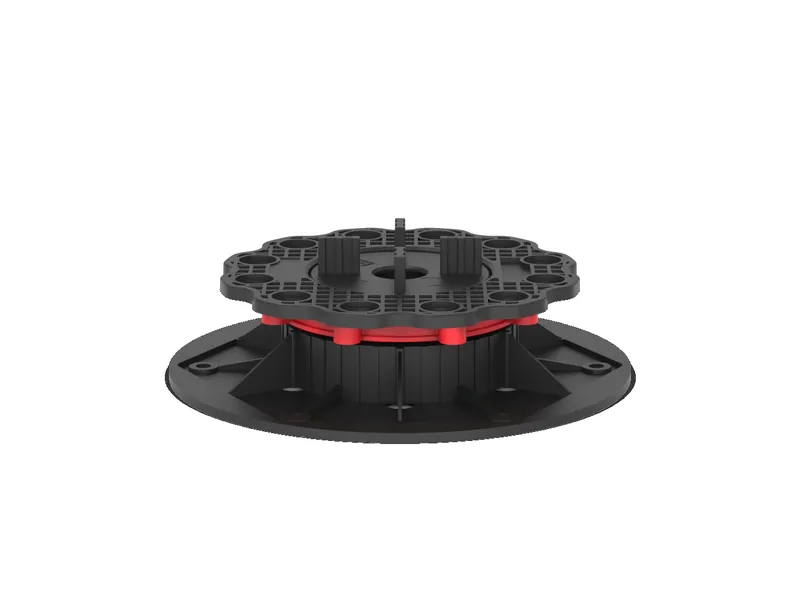
Choosing a pedestal comes down to three numbers: the finished height, the load it must carry, and the head type. Get those right and the series selects itself.
1. Work out the finished height
Measure from the structural slab (or membrane) to your target finished floor level. This is your total build-up. Vitaro pedestals cover:
- F Series: 20–185 mm (low build-ups, balconies)
- B Series: 20–260 mm (general decks and paving)
- HE Series: 25–392 mm (large raised decks, tall podiums)
If you need more than the standard range, add 100 mm or 150 mm extenders.
2. Calculate the load
Estimate the dead load (slab/tile/deck weight) plus live load (people, furniture, snow) per square metre, then divide by the pedestal grid spacing to get load per pedestal. Vitaro maximum loads:
- B Series: up to 3,500 kg per pedestal
- F Series: up to 2,200 kg per pedestal
- HE Series: up to 2,000 kg per pedestal
Load capacity falls as height rises — always check the model table for your exact height.
3. Pick the head type
Use a fixed head on flat substrates. On sloped roofs or uneven decks, choose the self-leveling head (±5°), which auto-compensates so the finished surface stays flat.
4. Compare Vitaro series
| Series | Height | Max load | Best for |
|---|---|---|---|
| HE | 25–392 mm | up to 2,000 kg | Large raised decks, podiums, rooftops |
| B | 20–260 mm | up to 3,500 kg | Best-value decks & tiling, high load |
| F | 20–185 mm | up to 2,200 kg | Balconies, low voids, fine paving |
Full specs: HE Series · B Series · F Series.
5. Common mistakes
- Specifying by max catalogue load instead of load at the actual height.
- Forgetting the self-leveling head on sloped roofs — then shimming on site.
- Under-spacing pedestals to save cost, then exceeding per-pedestal load.
- Using a mortar bed where a pedestal grid would be faster and re-levelable.
Frequently asked questions
How do I choose the right adjustable pedestal height?
Measure from the structural slab (or membrane) to your target finished floor level - this is your total build-up. Vitaro covers F Series 20-185 mm (low balconies), B Series 20-260 mm (general decks and paving) and HE Series 25-392 mm (large raised decks and podiums). If you need more than the standard range, add 100 mm or 150 mm extenders.
How do I calculate the load per pedestal?
Estimate the dead load (slab, tile or deck weight) plus live load (people, furniture, snow) per square metre, then divide by the pedestal grid spacing to get load per pedestal. Vitaro maximums are B Series up to 3,500 kg, F Series up to 2,200 kg and HE Series up to 2,000 kg - but capacity falls as height rises, so always check the table at your exact height.
Which pedestal series is best for a balcony versus a tall rooftop podium?
For low build-ups such as balconies and fine paving, the F Series (20-185 mm) is the compact choice. For general decks and tiling where value and high load matter, the B Series (20-260 mm, up to 3,500 kg) is the default. For large raised decks, tall podiums and rooftops, the HE Series (25-392 mm) is the right range.
Should I use a fixed head or a self-leveling head?
Use a fixed head on flat substrates. On sloped roofs or uneven decks, choose the self-leveling head, which auto-compensates up to +/-5 deg so the finished surface stays flat without on-site shimming.
About this guide
This guide is written by the engineering team at Shandong Uno Industrial Co., Ltd. (Vitaro® / Uno Industrial), a China-based manufacturer of adjustable pedestals. Our pedestals are CE- and UKCA-marked under the EU Construction Products Regulation (CPR 305/2011) and produced in our own factory with in-house tooling and moulds. The body is polypropylene reinforced with 10% glass fibre (HE Series), rated from -40°C to +120°C.
We supply the US, UK, Netherlands, Canada, Australia and Germany, and in 2024 we supplied pedestals for a rooftop terrace project in Slovenia. For a load table or a project-specific spec check, email bolton@unoindustrial.cn or tap the quote button below.